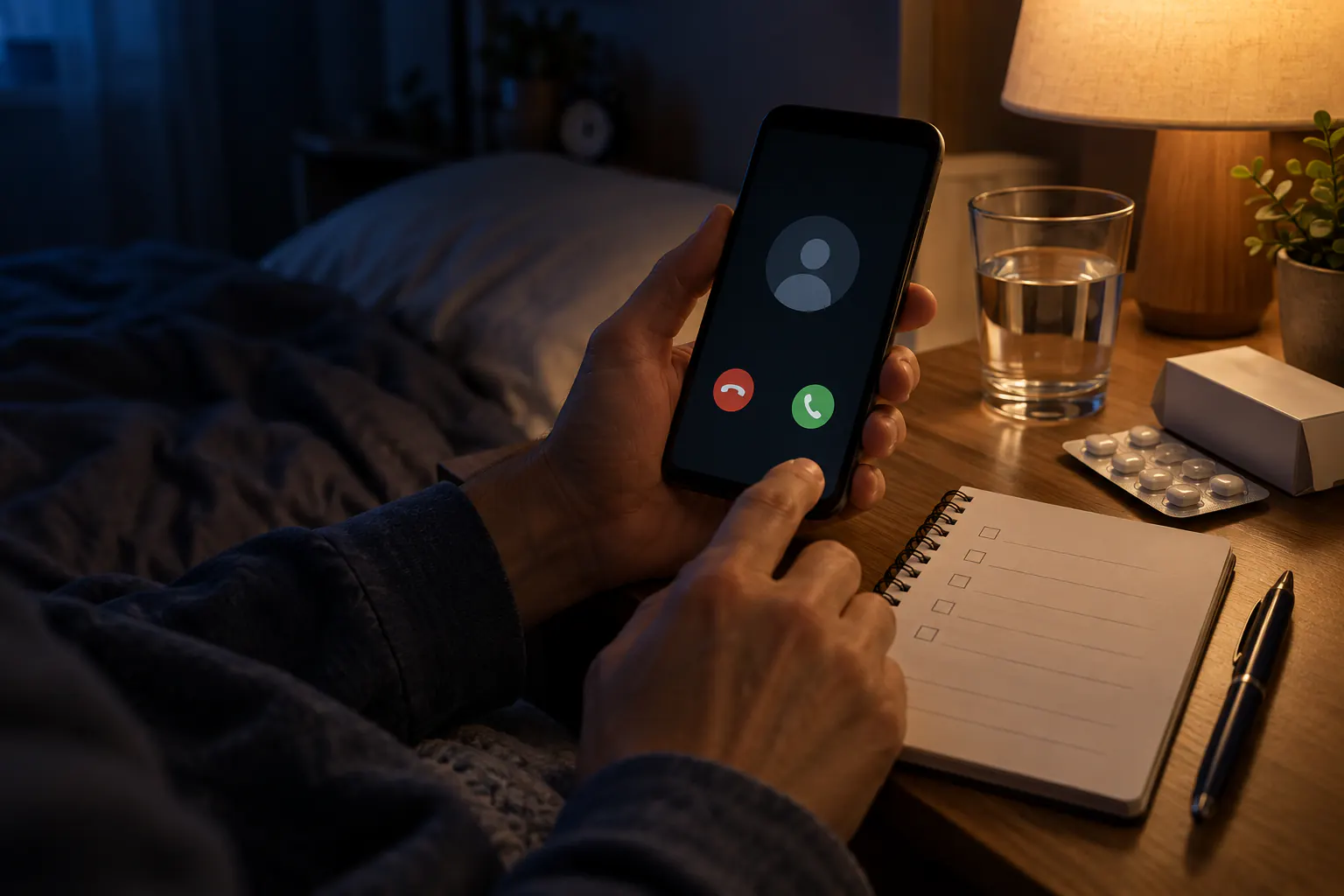
What information will you be asked for?
Age, the main symptom and when it started, how the person is behaving, ongoing medical conditions, all current medicines and allergies, and the exact address with a contactable phone number.
Most after-hours problems are not emergencies
This page assumes you have already ruled out the time-critical warning signs. If you have not, read them first. For a suspected heart attack or stroke, severe breathing difficulty, unresponsiveness or heavy bleeding, call an ambulance on 998 instead of reading on.
- 1
The person
Age, and weight if it is a child, because paediatric dosing depends on it.
- 2
The symptom
What it is, when it started, and whether it is better, the same or worse than an hour ago.
- 3
The function
What they can and cannot do: walk, talk in full sentences, keep fluids down, stay awake.
- 4
The history
Ongoing conditions, recent surgery, pregnancy, recent travel.
- 5
The medicines
Everything regular, anything taken tonight, and any known allergy. Have the packets to hand.
- 6
The location
Building, floor, apartment, and a phone that will be answered.
What should you avoid doing before advice?
Do not take another person's medicine, do not mask abdominal pain with strong painkillers, do not give food or drink to someone who may need urgent surgery, and do not drive a person with possible heart or stroke symptoms yourself.
- Do not start leftover antibiotics
- Do not double a missed dose without advice
- Do not apply ice, butter or toothpaste to a burn
- Do not remove an object embedded in a wound
- Do not move someone with a possible spinal injury
- Do not delay calling 998 to search for a clinic first
What should you confirm before the call ends?
Confirm what you have been advised to do now, what would change the plan, when to expect contact or arrival if a visit is arranged, and which symptoms mean calling emergency services instead of waiting.
Write down the safety net
The most useful part of any night-time call is the list of symptoms that mean stop waiting and call 998. Ask for it explicitly if it is not offered.
Common questions
What if I do not speak the same language as the clinician?
Say so at the start of the call. Ask whether another language is available, and keep a family member who can interpret nearby rather than guessing at medical detail.
Should I send photographs?
Only if asked, and only through a channel the provider names. Photographs can help with a rash or a wound, but they cannot replace an examination.
Does this site arrange the visit?
No. This is an independent information guide. Requests are passed to a provider, and the provider decides whether and when a visit is appropriate after triage.
Sources