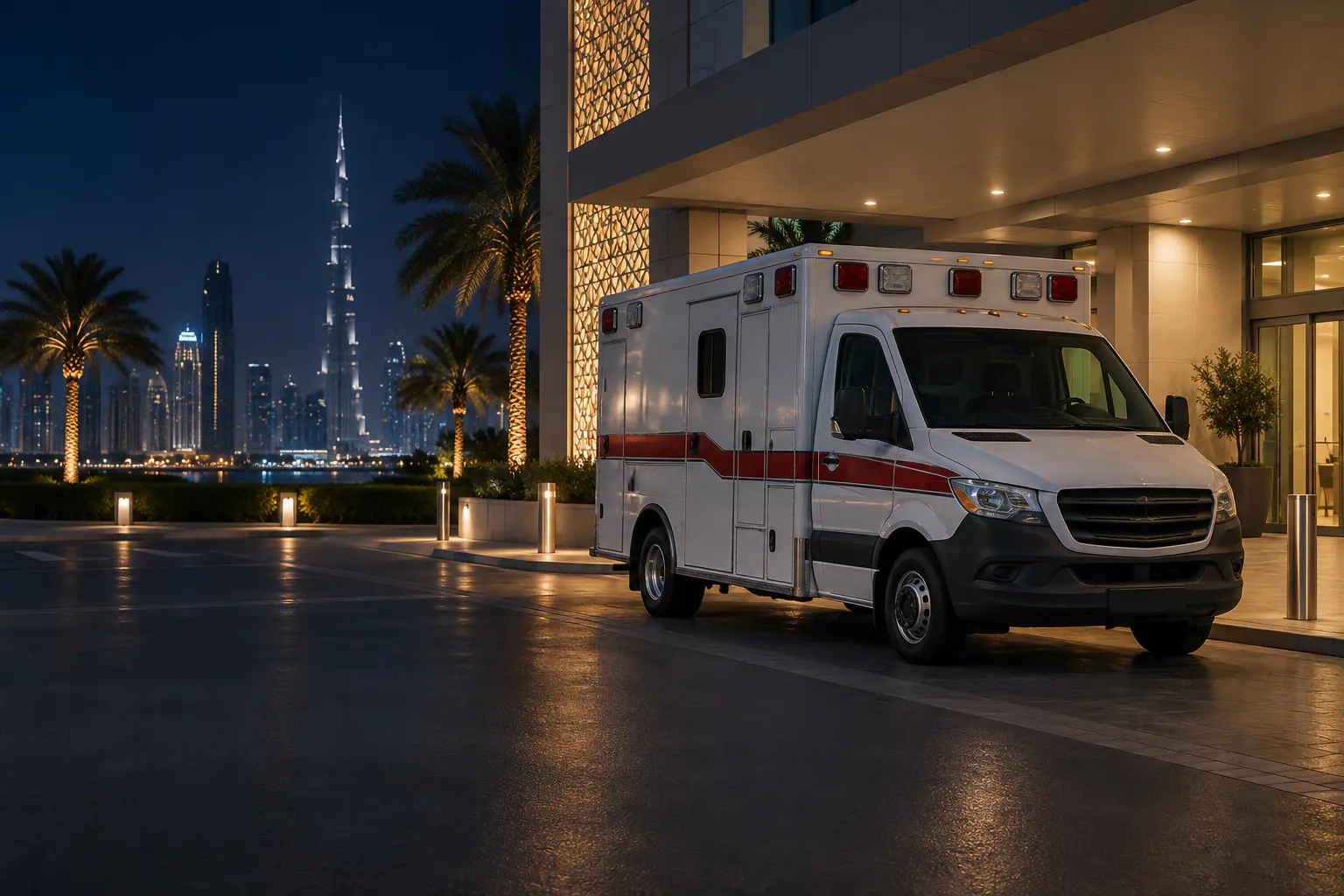
Which symptoms mean calling 998 now?
Call an ambulance for symptoms that suggest the heart, brain, airway or circulation is failing. These need treatment that starts on the way to hospital, which is why transport by ambulance matters more than speed of arrival at any clinic.
Life-threatening symptoms: call 998 for an ambulance
In the UAE, 998 is the ambulance number, 999 is police and 997 is civil defence. Do not wait for a WhatsApp reply, a callback or a home-visit window when someone may be having a heart attack or stroke, cannot breathe, is unresponsive, is bleeding heavily or is deteriorating quickly.
- Chest pain or pressure lasting more than a few minutes, or with sweating, nausea or pain in the arm, neck or jaw
- Face drooping, arm weakness or speech difficulty — even if it passes
- Struggling to breathe, unable to complete a sentence, or lips turning blue
- Not responding normally, a first seizure, or a seizure lasting more than five minutes
- Bleeding that soaks through dressings despite firm pressure
- Swelling of the lips, tongue or throat after a sting, food or medicine
- A head injury followed by vomiting, drowsiness or confusion
Sources: World Health Organization — stroke; World Health Organization — cardiovascular diseases
What counts as urgent but not an emergency?
Urgent means it should be assessed tonight or early tomorrow, but the person is stable enough to travel and to wait a short time. This is where a 24-hour clinic or a home visit genuinely fits.
- A fever with no warning signs, in someone who is drinking and alert
- Persistent vomiting or diarrhoea without signs of significant dehydration
- A wound that may need closing but is not bleeding heavily
- Moderate pain that is not improving with simple measures
- A suspected sprain or a minor burn
- A medicine problem — a missed dose, a reaction, or running out
The honest test is whether the person is stable. If you would be comfortable sitting in a waiting room with them for an hour, the situation is urgent rather than an emergency.
When is waiting until morning the safer choice?
Waiting is right when the symptom is mild, unchanged and has an obvious explanation, and when the person is eating, drinking and behaving normally. Night-time assessment adds little for problems better handled by a clinician who holds the medical record.
Waiting is an active decision
If you decide to wait, decide what would change your mind — a rising temperature, worsening pain, reduced drinking, new drowsiness — and check again rather than going to sleep on it.
Common questions
What if the symptom passes before I call?
Some time-critical symptoms resolve and return. Weakness, slurred speech or visual loss that passes within minutes still needs urgent assessment, because it can precede a larger event.
Will I be charged for calling an ambulance?
Ambulance access does not depend on your ability to pay, and you should never delay calling 998 because of cost. Billing questions for any subsequent hospital care are separate and can be resolved afterwards.
Can I drive someone to hospital instead of calling 998?
For a possible heart attack, stroke or breathing failure, no. Ambulance crews begin treatment immediately and take the patient to a facility equipped for that problem. Driving also puts a distressed driver on the road.
Sources